
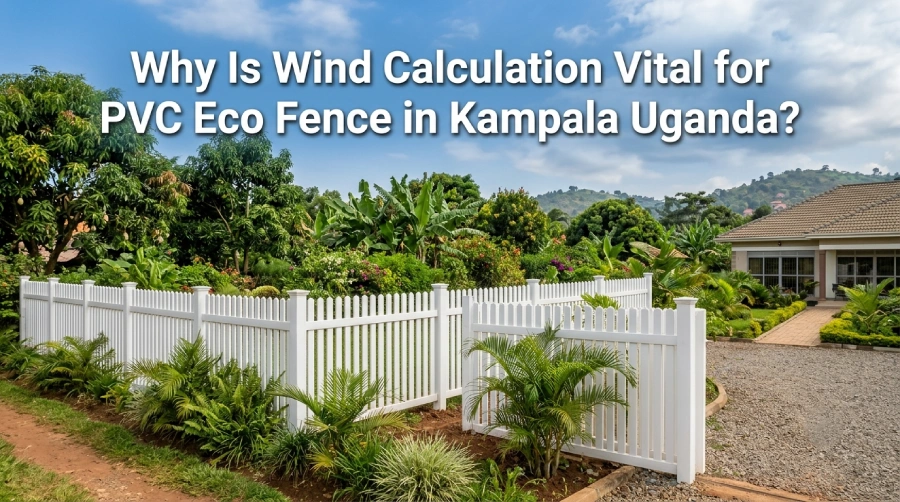
Why Is Wind Calculation Vital for PVC Eco Fence in Kampala Uganda?
Installing a PVC eco fence in Kampala Uganda requires more than choosing an aesthetically pleasing design and durable materials. Wind conditions, installation methods, fence height, and ground stability all influence how well a fence performs over time. Although PVC fencing is equally valued for its low maintenance, clean appearance, and weather resistance, it must be designed to resist the wind forces acting on its surface. Without proper wind calculations, a fence might experience extreme leaning posts, structural damage, and loose connections during strong gusts. Kampala’s varied terrain and exposed properties make site-specific assessment particularly imperative.
In this guide, we will explore the importance of wind calculations for a PVC eco fence in Kampala Uganda, and the factors that affect them. As we all know, understanding these differences helps property owners make informed decisions. Whether you are securing a residential property, industrial compound, or commercial facility, proper planning helps ensure your PVC eco fence delivers the intended combination of durability, privacy, and security.
What is Wind Calculation and How to Measure It?
Wind calculation estimates the force that moving air exerts on a structure. For fencing, it helps determine whether the posts, panels, foundations, and fasteners can resist the expected wind pressure at a specific location. The calculation considers factors such as wind speed, panel dimensions, fence height, exposure, and surrounding obstacles. Because solid PVC panels can present a relatively extensive surface to the wind, estimating these forces before installation is vital. The outcome helps guide practical design decisions, improve fence stability, and reduce structural risks throughout its service life.
Calculations of Wind:
Wind load calculation is done based on wind speed, air density, and the appropriate aerodynamic pressure coefficient. An equation for basic wind pressure is given as:
q = ½ρV²
Where:
- q – basic wind pressure in pascals (Pa).
- ρ – air density in kilograms per cubic meter (kg/m³).
- V – wind speed in meters per second (m/s).
The above equation represents an initial equation and not a calculation for designing a fence. In calculating the actual design pressure, one should consider the applicable wind code, the environment in which it applies, gust effect, aerodynamic coefficients, and necessary safety factors. The calculated pressure is then used to calculate the force exerted on the fence face. If a simple uniform pressure model is used, the force can be obtained by F = p x A, where p represents the design pressure and A the exposed area.
What is PVC Eco Fence?
The PVC ecological fence refers to the type of fence that utilizes polyvinyl chloride (PVC) plastic, which is a tough thermoplastic used for residential, commercial, agricultural, and industrial purposes. This fence is highly popular since it is resistant to moisture and does not corrode like bare metal and usually needs less maintenance compared to traditional wooden fences. However, its effectiveness is dependent on the quality of the material, UV protection, design of the fence panels, and installation. When choosing a PVC eco fence in Kampala Uganda, one must take into account both the conditions and the construction needs. The solid panel provides privacy but is subjected to higher wind pressures than open or slatted panels.
Significance of Wind Calculation for PVC Eco Fence
Wind calculation is an essential part of choosing and installing a PVC eco fence in Kampala Uganda. Thus, the following considerations explain how wind assessment contributes to safer installation, improved sustainability, and better long-term performance. Check it out:
1. Contributes to Structural Stability
The impact of wind can lead to bending of fence panels, tilting of posts, and overturning forces on the foundation. Estimating the potential load will help identify if the selected posts, rails, connections, and foundations will be able to withstand the fence in expected conditions. This applies especially to tall and continuous PVC panels. Structural estimation decreases the possibility of fence instability.
2. Assists with Choosing an Optimal Fence Design
Not all PVC fence types react to wind pressure in similar ways. For instance, while solid panels are effective in providing good privacy, their surfaces are exposed to high pressure. Slatted fences let some air go through. Wind assessment allows comparing both variants according to property needs. In this case, the fence is not bought based only on aesthetics but taking into account privacy, security, and structural stability as well.
3. Promotes Proper Spacing Between Posts
The distance between the posts has an impact on the way loads move from the panels to the structure that supports them. The distance might affect the way the panel deflects or put further stress on the rails and their connections. Wind load calculation will help to determine proper spacing depending on the height of the fence, stiffness of the panel, and the amount of pressure applied.
4. Minimizes the Risk of Wind Damage
A badly designed PVC eco fence in Kampala Uganda can be damaged by high winds because of poor anchoring of the posts and weak connections of the panels. The calculations of wind loads before the installation can help to detect vulnerable parts of the fence and reinforce them accordingly. This step can save money for repairs, replacements, and maintenance.
5. Helps to Determine the Requirements for Foundation
Since the fence foundation will have to withstand forces that will be transferred through the posts, including bending forces and overturning, wind calculations provide information that is helpful in calculating the required size of footings, required embedment, concrete work, and also the soil issues. The right foundation will depend on the design load and not necessarily the same depth of the foundation for all properties.
Factors Affecting Wind Load on PVC Eco Fences
Several variables determine the extent of wind force that will act on the PVC eco fence in Kampala Uganda. The most significant variable is the wind speed since the basic velocity pressure varies directly as the square of the wind speed. Moreover, the height of the fence and area of the exposed face contribute to the forces applied on the fence. Additionally, variables such as the terrain, presence of other structures, vegetation, slat design, and wind direction may affect the pressure on the fence. The soil type and post footing designs will affect the ability of the fence to resist these forces.
The following are some factors that need to be evaluated:
- Wind speed: The higher the wind speed, the greater the pressure exerted.
- Fence height: The taller the fence, the higher the wind forces acting.
- Panel surface area: Larger continuous panels may attract more loads.
- Panel porosity: Slatted or perforated panels will allow airflow based on their design.
- Terrain and exposure: Open terrain and elevated locations may experience winds differently.
It’s Time to Wrap Things Up!
At Global Matco Industry, we understand the significance of choosing the right fencing solutions that combine practical performance with an appealing finish. If you are considering a PVC eco fence in Kampala Uganda, our team can help you explore suitable options for your property’s needs, preferred design, and intended application. From residential boundaries to industrial and commercial spaces, making an informed choice begins with understanding your needs.
Do not wait any longer! Connect with us today and let’s discuss your PVC eco fencing project and take the next step towards a well-planned, durable fencing solution for your property.
Frequently Asked Questions
It helps to understand how much pressure acts on panels and supporting elements. It helps to make decisions regarding the distance between posts, reinforcement, joints, anchoring, and other features. It helps to avoid tilting, deformation, and wind damage.
One of the possible ways is calculation of basic velocity pressure using a simple velocity pressure equation.
- Calculate basic velocity pressure using wind speed and air density
- Apply correct pressure coefficients
- Use the correct design factor
- Estimate force using design pressure multiplied by the area
- The full wind design should be done according to wind standards
If the product is designed for outdoor use, PVC fencing can be suitable for the climate of Kampala. UV stabilization, high-quality materials, good drainage systems, proper installation, and other features help.
The solid fence will have a large continuous surface facing the wind. A properly designed slatted fence will have less wind load, but its efficiency will depend on many factors.
Price will be determined by many things such as fence height, length of the fence, style of the panels, quality of materials, reinforcing posts, foundations, accessibility to the site, and labor. Wind conditions at the particular site might determine the price too.