
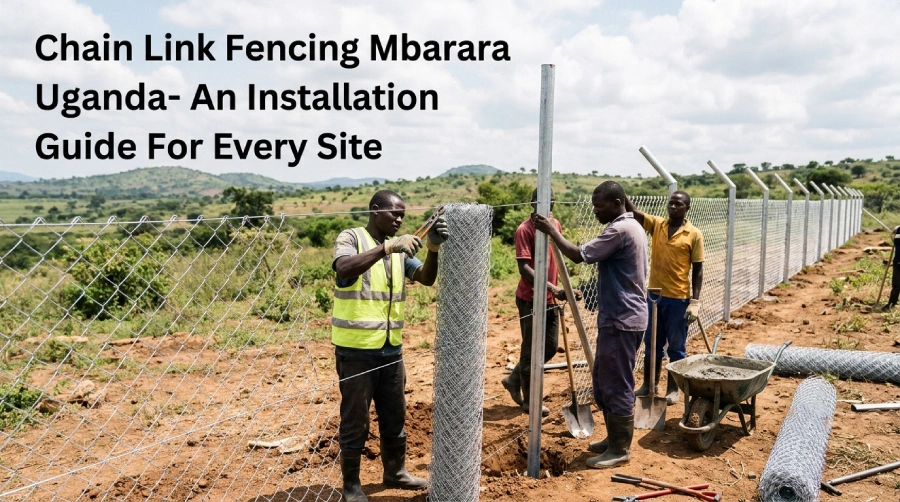
Chain Link Fencing Mbarara Uganda- An Installation Guide For Every Site
In order to secure commercial, agricultural, industrial, and residential properties, there is a need for fencing that will be affordable, functional, and durable. Chain link fencing Mbarara Uganda is becoming one of the most preferred solutions for many property owners who require a fence that offers security but does not hinder ventilation or visibility. Nonetheless, the durability of the fence does not depend only on the type of mesh used. Site evaluation, use of proper material, proper fixing of the posts, measuring, and tensioning are some of the aspects involved.
Whether you are fencing a small residential plot or a large agricultural property, understanding the installation process can help your project effectively. In this comprehensive blog post, we will discuss the fundamental installation procedure of chain link fencing Mbarara Uganda, its technical configuration, and more for different sites.
What is Chain Link Fencing?
Chain link fencing Mbarara Uganda is a boundary protection system made from interwoven steel wires that form a continuous diamond-shaped mesh. The mesh is securely installed on posts and supported by tension wires or rails, depending on the design and intended application. PVC-coated and galvanized options improve corrosion resistance and environmental exposure. Therefore, its open structure provides airflow, visibility, and natural light while clearly defining the property boundary. Chain-link fencing is commonly used for sports facilities, commercial properties, schools, agricultural land, industrial sites, and residential premises. From a practical installation perspective, its performance depends on wire gauge, post spacing, foundation stability, correct tensioning, and mesh size. Choosing accurate specifications helps property owners get a fence that meets their security needs, withstands regular use, and remains economical to maintain.
Key Features of Chain Link Fencing
- Wire mesh is a durable material for boundary fencing if constructed according to proper specifications.
- Galvanized or PVC-coated wire protects from corrosion.
- It is an economical solution for fencing small and large properties.
- Its open design allows good visibility around the boundaries.
- It is used in houses, farms, schools, playgrounds, warehouses, and industrial property.
Technical Configuration of Chain Link Fencing
| Technical Component | Typical Specification |
|---|---|
| Fence Height | 1.2–2.4 metres or as required |
| Mesh Opening | Approximately 40–75 mm |
| Wire Gauge | Commonly around 2.5–3.5 mm |
| Fence Posts | Steel, concrete, or treated timber |
| Post Spacing | Approximately 2–3 metres |
| Foundation Depth | Commonly 450–750 mm, subject to conditions |
| Surface Finish | Galvanized or PVC-coated steel |
| Support System | Tension wire, straining posts, and optional rails |
| Gate Configuration | Steel-framed swing or sliding gate |
Significant Materials and Tools Used in Chain Link Fencing
An effective installation of a chain link fence Mbarara Uganda requires high-quality materials and proper installation tools. Each material and tool plays a role in determining how stable, durable, and aesthetically pleasing the fence will be. It is necessary to have an inventory of the quantity required, check whether there is damage in the materials used, and make sure that the tools are suitable for use. The materials and tools that are important include:
- Chain link Mesh: It forms the main body of the fence and is dependent on the height and gauge wire required.
- Fence Posts: They provide structure and keep the fence straight.
- Cement, sand, and aggregate: These help in making concrete for the foundations of the posts.
- Tension wires and Rails: They help in maintaining the structure of the fence and keeping it at the same tension level.
- Binding Wire and tension bars: They help in attaching the mesh to the posts and other accessories.
- Measuring tape and spirit level: They help in measuring distances, heights, and levels.
- Pliers, wire cutters, and spanners: They are useful in the installation process by cutting, fastening, and tightening.
Step-by-Step Installation Process of Chain Link Fencing for Every Site
The installation procedures mentioned below apply to various fences, including those in residential areas and agricultural or commercial farms. However, the procedure is the same and should be adjusted to match the terrain, soil type, and security needs.
1. Inspect the Site and Mark the Boundary
The first step is to conduct an inspection of the site to find out the boundary of the intended chain link fencing Mbarara Uganda, the nature of the ground, its slopes, drainage lines, and any other obstructions on the ground. The property lines must be marked before the location of the fence is marked, especially when there are many properties within a small area.
2. Measure Area and Make Plan Layout
The entire area covered by the fence is to be measured, and the positions of the corner, end, intermediate, and gate posts are marked. It is advisable to use a string line to ensure a straight-line orientation in the plan layout. The amount of mesh to be used can be calculated from the perimeter, the desired height, and adjustment or cutting allowance. Changes in directions and elevations of the surface should be identified before digging.
3. Dig Holes for Posts and Install Major Posts
Post holes are to be dug according to the plan layout with due regard to the nature of the soil, height of the fence, and loading requirements. Corner, end, and gate posts should be installed first since they have considerable tension and forces of operation applied to them. The posts should be set up vertically and fixed in place with concrete if required. A spirit level and a string line should be used to check the alignment before the setting of the concrete.
4. Fix Intermediate Posts and Support Elements
After the installation of the main posts is complete, fix the intermediate posts at the required intervals. Pay attention to equal height and alignment of posts and adjust to the terrain level. Put tension wires, rails, braces, or other support elements depending on the chosen type of chain link fencing Mbarara Uganda. It is vital to properly brace the fence at the corners and at the end posts since these areas have a higher level of pulling forces. At this step, you create a sturdy structure that can prevent the sagging, shifting, and distortion of the chain link fabric.
5. Unroll and Fix the Chain Link Fabric
Place the fabric roll next to an end post and unroll it along the fenced area. Fix the starting edge with a tension bar or any other fixation tool. Make sure the fabric does not touch any obstacles that might harm the protective layer of the mesh and distort the wire. Join the fabric sections smoothly in order to keep the diamond shape of the fence.
Concluding Note!
At Global Matco Industry, we understand the significance of having efficient chain link fencing Mbarara Uganda that meets the aspects of functionality, quality, and professional planning. With a team of skilled and experienced experts, we are here to assist you in determining your fence requirements, choosing appropriate materials, and selecting the strategy that will fit your property. Regardless of whether your fence is required for your residential area, agricultural land, or commercial premises, making sound judgments should be the starting point for an efficient fence solution.
So, what are you waiting for? Connect with our team today and let’s discuss your upcoming project and take the next step towards a secure, well-planned fencing installation.
Frequently Asked Questions
This varies depending on the total perimeter, height of the fence, wire thickness, coating, materials used for posts, terrain, and labour costs. It can also be increased by additional costs incurred in installing the gates and digging in difficult terrain. Ask for a quotation based on your specific site.
The best height will depend on the nature of the property.
- Residential properties: A height of 1.2 – 1.8 metres may be adequate for boundary identification.
- Farmland or garden: A height of 1.5 – 2.0 metres may be adequate for most containment needs.
- Higher-risk properties: Depending on the risk assessment, 2.0 – 2.4 metres or higher may be appropriate.
Yes, galvanized chain link fences would work well outdoors due to their protective coating of zinc that keeps the steel protected from rusting.
A small residential job might be done within a few days, but larger areas and properties that have tough terrain might take longer than this. Site preparations, concrete drying time, installation of gates, and weather conditions might affect the time frame.
Some of the materials that are used for chain link fencing include the following: chain link material, posts, concrete, tension wire, fastening materials, and gates.
